

Sound from above: how spatial audio can pull you inside a song
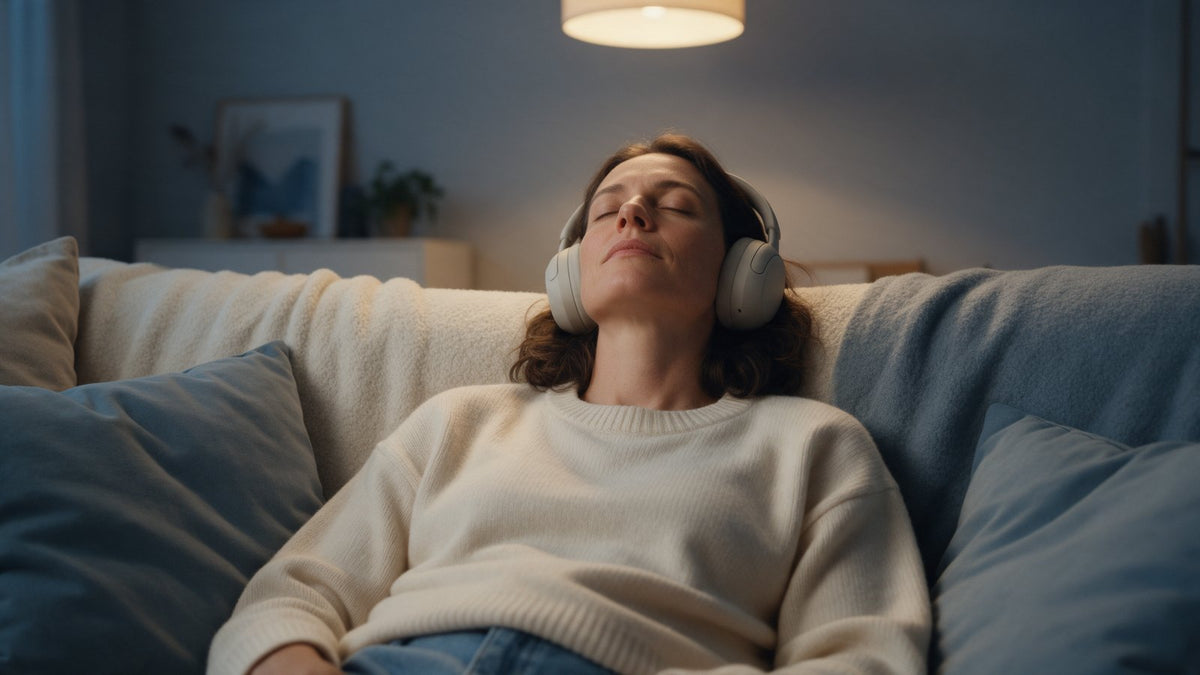
Close your eyes on a park bench. A bird calls somewhere above and to your left. A bike passes behind you. You could point to each one without looking.
That everyday skill is what spatial audio tries to borrow. For decades, most music came in stereo: sound placed somewhere on a line between a left speaker and a right one. Spatial audio adds the rest of the room, including above your head. So how does a pair of headphones fake a bird in a tree?

How your ears find a sound
You have two ears, a head between them and a pair of oddly shaped outer ears. Together they work like a direction finder.
A sound from your left reaches your left ear less than a millisecond before your right one. It is also a little louder on that side, because your head casts a sound shadow. Your brain reads both differences to place the sound from left to right.
Height is harder. Here your outer ears do the work. Their folds change the tone of a sound slightly, depending on whether it arrives from above, below, in front or behind. Your brain has learned what those small changes mean, and it compares each sound with that stored map. That is how you can tell the bird is up in a tree and not at your feet. A classic review in the Annual Review of Psychology sums up decades of work on these left, right and height cues.
What spatial audio does differently
Stereo has two channels. Surround sound added more speakers around the room. Formats such as Dolby Atmos go a step further. Instead of tying each sound to a speaker, the mixer places it as an object at a point in space, including overhead. Your system then works out how to play it on whatever you own: a cinema, a home setup, or a pair of headphones.
The format started in cinemas. Dolby Atmos made its debut in June 2012 with Pixar's Brave, at first in just 14 theaters in the US and Canada. Sound designers could now place a sound overhead or move a helicopter across the audience instead of sliding it from one wall to the other.
Music took a while to follow film. In 2021, Apple Music announced Spatial Audio with Dolby Atmos for its subscribers. Apple described it as sound that comes "from all around and from above."
On headphones, there are no speakers above you, so software fakes the cues your outer ears would add. It filters each sound to mimic how it would reach you from a given direction. Many systems, Apple's among them, use a generic ear model built from measurements of many people. In 2022, Apple announced that iPhone owners would be able to create a personal profile with the phone's front camera, to tune that filter to their own ears.

Why height matters so much
Most of what moves around us in daily life happens at ear level: voices, cars, footsteps. Sound from above is rarer, which may be why it stands out when a mix uses it. Rain on a roof, a bird in a tree, the echo of a high ceiling: these are the kinds of cues that can make a scene feel like a place.
So height works best in small doses. A choir that floats slightly above you, or a guitar that drifts overhead in a bridge, can turn a familiar song into something you notice again. For more on how a space shapes what you hear, read the room becomes the instrument.
Why it can feel more real
Researchers have a word for the feeling of being inside a scene rather than watching it: presence. They have asked whether sound raises presence, and whether placing it accurately in space adds to that.
In a 2015 study in Presence, researchers in Japan played the sound of people approaching the listener through a 96-speaker system. In one version the sound was reproduced with higher spatial accuracy, in the other with lower accuracy. People rated their sense of presence higher with the more accurate version.
A measure of their sympathetic nervous system, the body's arousal system, was also higher, in a pattern the authors compared to what happens when someone enters your personal space. In the more accurate version, higher presence ratings went along with a stronger body response.
A 2020 study in Frontiers in Robotics and AI had about 40 people in each of two experiments walk on a treadmill through a virtual park in a VR headset. Adding a nature soundscape raised ratings of presence and realism.
Footstep sounds that matched their steps raised them too. In the first experiment, the steps were rated as poorly in sync and made little difference. After the team improved the timing, the effect was large.
The authors suspect timing explains the difference, though the two experiments also used different people and a different questionnaire. The lesson for anyone mixing sound for a scene: the sound has to match what you see and do.
The catch
These were lab studies. They mostly measured a feeling through ratings, only one also tracked the body, and the VR experiments had about 40 people each, mostly students. A 96-speaker lab is not a pair of earbuds. Simulated height cues built on an average ear can place sounds in the wrong spot for some listeners. And not every track gains from a spatial mix. A careless one can sound thin or oddly far away, and some songs simply work better in stereo. Think of it as a tool, and judge it track by track.
How to try spatial audio at home
- Start with a track made for it. Look for songs labeled Dolby Atmos or Spatial Audio in your streaming app. Mixes made for spatial audio from the start can sound different from older songs converted later, so try a few and trust your ears.
- Compare it with stereo, with your eyes closed. Play the same chorus both ways. Point to where the voice, the drums and the guitar sit.
- Try head tracking on and off. Some headphones keep the sound fixed in the room as you turn your head. Preferences differ, so try both.
- Keep the volume at a comfortable level. Space comes from placement, not loudness.
- For a film, sit in the middle. Home systems place the effect around a central seat.
Where the bass fits in
Spatial audio is mostly about where a sound is. The low end is about how much of it you feel. A bass line in a club lands in your chest, not at a point in space. Those two layers do different jobs, and good mixes can use both. Our earlier stories looked at why bass makes you dance and at the whispered vocals that feel close enough to touch.
Back to the bench
Your ears have always heard in three dimensions. For most of recorded music, the speakers did not. Spatial audio is a step toward matching how we hear the world. So the next time a song starts, close your eyes and try the bench test: can you point to where each sound lives?
This article is for general information only and is not medical advice.
Sources
- Middlebrooks JC, Green DM. Sound localization by human listeners. Annual Review of Psychology, 1991.
- Apple Newsroom. Apple Music announces Spatial Audio with Dolby Atmos, 17 May 2021.
- What Hi-Fi? Apple's iOS 16 lets users personalize spatial audio for AirPods with the iPhone's TrueDepth camera, June 2022.
- Engadget. Dolby confirms 14 theaters for inaugural screening of Pixar's Brave with Atmos audio, June 2012.
- Kobayashi M, Ueno K, Ise S. The effects of spatialized sounds on the sense of presence in auditory virtual environments: a psychological and physiological study. Presence: Teleoperators and Virtual Environments, 2015.
- Kern AC, Ellermeier W. Audio in VR: effects of a soundscape and movement-triggered step sounds on presence. Frontiers in Robotics and AI, 2020.

