

Vibration plate or vibroacoustic? Simple shaking versus sound you feel
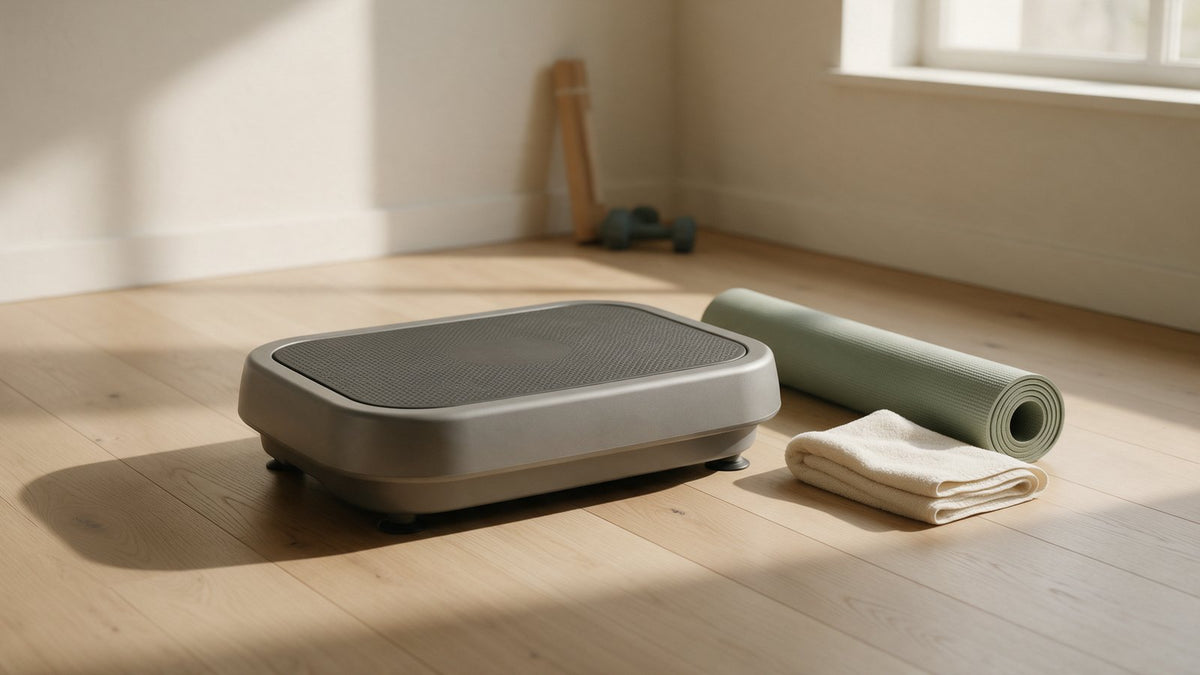
A buzzing platform, a squat, a timer. In the US, interest in "vibration plate" doubled in the past year on Google Trends, and the machines now show up in gyms and living rooms.
If you also read about vibroacoustic beds and mats, the two can sound like cousins. Both are felt through the body, and both are sold for home use. The similarity mostly ends there. They differ in how hard they move you, how you use them and what researchers have measured.
Vibration plate vs. vibroacoustic: the short answer
- How you use it: on a vibration plate you usually stand, squat or hold a pose. A vibroacoustic bed or mat is for lying or sitting still.
- What moves: a plate is a motor-driven platform that shakes the whole body through the feet. A vibroacoustic surface plays low sound through built-in speakers, usually mixed with music.
- How strong: plates are strong enough to make leg muscles work. In the vibroacoustic trial described below, listeners could adjust the intensity.
- What research measured: the plate studies described here measured muscle activity, acceleration and flexibility. The vibroacoustic studies described here measured relaxation and the body's rest signals in healthy adults.

How a vibration plate works
A vibration plate is a platform driven by a motor. Many fall into two families. Vertical plates move straight up and down. Side-alternating plates tilt around a center point like a seesaw, so one foot rises as the other drops.
Two settings define the ride. Frequency is how many times a second the plate moves, measured in hertz (Hz). Amplitude is how far it travels, measured in millimeters. Together they set the force. The lab studies in this article used between 5 and 35 Hz.
That force can be large. In a 2010 study in Clinical Biomechanics, researchers in London put 15 healthy adults on a plate running at 5 to 30 Hz, moving 2.5 or 5.5 mm, and tracked their movement in 3D. Near the feet, the motion reached about 9 g, nine times the pull of gravity. It faded on the way up the body, and at the head it never passed 0.33 g. In a second group of 12, leg muscle activity rose to 5 to 50 percent of maximum effort, which the authors suggested comes from the body steadying itself. They also warned that prolonged exposure may have adverse effects.
The type of plate matters too. A 2019 study in Dose-Response compared the two families in 12 healthy men at 20 to 30 Hz. At every setting, the seesaw plate sent more acceleration to the ankle than the vertical one. Posture changed the picture as well: standing and squatting carried the vibration differently up the body.
What plate research in healthy adults measured
Plate studies in young, healthy people mostly ask exercise questions.
One session and flexibility
- Who: 20 healthy young men in Rome, in a 2017 study in Medicine.
- Design: randomized into two groups. One group did 10 minutes of vibration at 35 Hz and 5 mm, in one-minute bouts, holding a half squat. The other held the same position on the plate with no vibration.
- Key result: flexibility, measured with a fingertip-to-floor reach, improved in the vibration group. Jump height rose by about 4 percent, and hamstring muscle activity fell. The comparison group did not change.
- The limit: a single short session, in 20 men.
Pooled results on flexibility
A 2013 meta-analysis in the Journal of Musculoskeletal and Neuronal Interactions pooled studies in young, healthy people. Across 13 studies with 324 participants, adding vibration to the same routine gave a small average extra gain in flexibility. At its lower end the estimate was close to no effect, and the authors wrote only that vibration might lead to additive improvements.
What each one feels like
On a plate, the sensation is busy. Your legs buzz, your muscles work, and holding still takes effort. A vibroacoustic session feels slower. A low hum rolls under the music and moves through your back and legs while you lie still. One asks your body to work. The other asks you to lie still.

How vibroacoustic sessions work
A vibroacoustic bed, chair or mat has speakers built in. They play low tones, classically 30 to 120 Hz, often woven into music. Its history goes back to Norway in the late 1960s. If you have ever wondered why felt bass moves people at all, our sister blog explains why bass makes you dance.
What vibroacoustic research in healthy adults measured
Two small studies in healthy adults looked at the relaxation side. In a blinded pilot trial in Frontiers in Psychology, 48 students were analyzed after a 20-minute session on a vibroacoustic bed, where each could set the level that felt right. Adding low sound (about 25 to 80 Hz) to the music shifted heart rate variability more than music alone. Yet self-rated stress dropped in both groups, with no significant difference between them, so the study cannot say what caused that change.
A 2024 study in Sensors recorded heart and brain signals in 38 adults during a 45-minute sound massage. The signals moved toward rest, but there was no control group. Both studies are covered in more detail in our guide to what vibroacoustic therapy is.
What the research does not show
- That one is better than the other. None of the studies here compared a plate with a vibroacoustic bed. They are built for different jobs.
- That a home device matches a lab device. The plates and beds in these studies were research equipment with known settings.
- Big claims you may see online. The studies here measured flexibility, muscle activity and relaxation signals in small groups of healthy adults. They say nothing beyond that.
Which one fits what you want?
- If you want a workout tool, a plate belongs with exercise. Start with short sessions and follow the maker's guidance.
- If you want to lie down and listen, vibroacoustic sessions are built for stillness and music. The music you choose matters.
- If you are curious about both, try each one in person first, at a gym or a wellness center.
Either way, start low, stop if anything feels uncomfortable, and if you are pregnant, have an implanted device or any health condition, ask a health professional first. The simple rule: pick the tool that matches what you want to do, work out or lie still with music. Curious about a third option? See sound bath vs. vibroacoustic therapy.
Questions to ask before you buy either
- Can I try it first? A gym, a fitness studio or a wellness center may let you feel one before you spend anything.
- How loud is it? Motors and speakers both make noise. Ask for the level, or listen in person if you share walls.
- What can I adjust? Look for a clear range of settings and a low starting point.
Frequently asked questions
Is a vibration plate the same as whole-body vibration? Yes. Researchers call it whole-body vibration (WBV), because the plate moves the whole body through the feet.
What frequency does a vibration plate use? The lab studies here used between 5 and 35 Hz. The 2017 flexibility study used 35 Hz. Vibroacoustic sessions classically use 30 to 120 Hz.
Can I use a vibration plate lying down? Plates are designed for standing and exercise, so follow the maker's instructions for posture. Vibroacoustic surfaces are designed for lying still.
This article is for general information only and is not medical advice. Talk to a qualified health professional about any health condition.
Sources
- Google Trends. "vibration plate", "vibroacoustic", United States, past 5 years (pulled 11 October 2026; last 52 weeks averaged 42 on Google's relative index, against 21 the year before).
- Pollock RD, Woledge RC, Mills KR, Martin FC, Newham DJ. Muscle activity and acceleration during whole body vibration: effect of frequency and amplitude. Clinical Biomechanics, 2010.
- Annino G, Iellamo F, Palazzo F, et al. Acute changes in neuromuscular activity in vertical jump and flexibility after exposure to whole body vibration. Medicine, 2017.
- Osawa Y, Oguma Y. Effects of vibration on flexibility: a meta-analysis. Journal of Musculoskeletal and Neuronal Interactions, 2013.
- Zaidell LN, Pollock RD, James DC, et al. Lower body acceleration and muscular responses to rotational and vertical whole-body vibration at different frequencies and amplitudes. Dose-Response, 2019.
- Kantor J, Vilímek Z, Vítězník M, et al. Effect of low frequency sound vibration on acute stress response in university students: pilot randomized controlled trial. Frontiers in Psychology, 2022.
- Fooks C, Niebuhr O. Effects of vibroacoustic stimulation on psychological, physiological, and cognitive stress. Sensors, 2024.
- Punkanen M, Ala-Ruona E. Contemporary vibroacoustic therapy: perspectives on clinical practice, research, and training. Music and Medicine, 2012.

