

Same movie, every December: why we rewatch holiday films, according to research
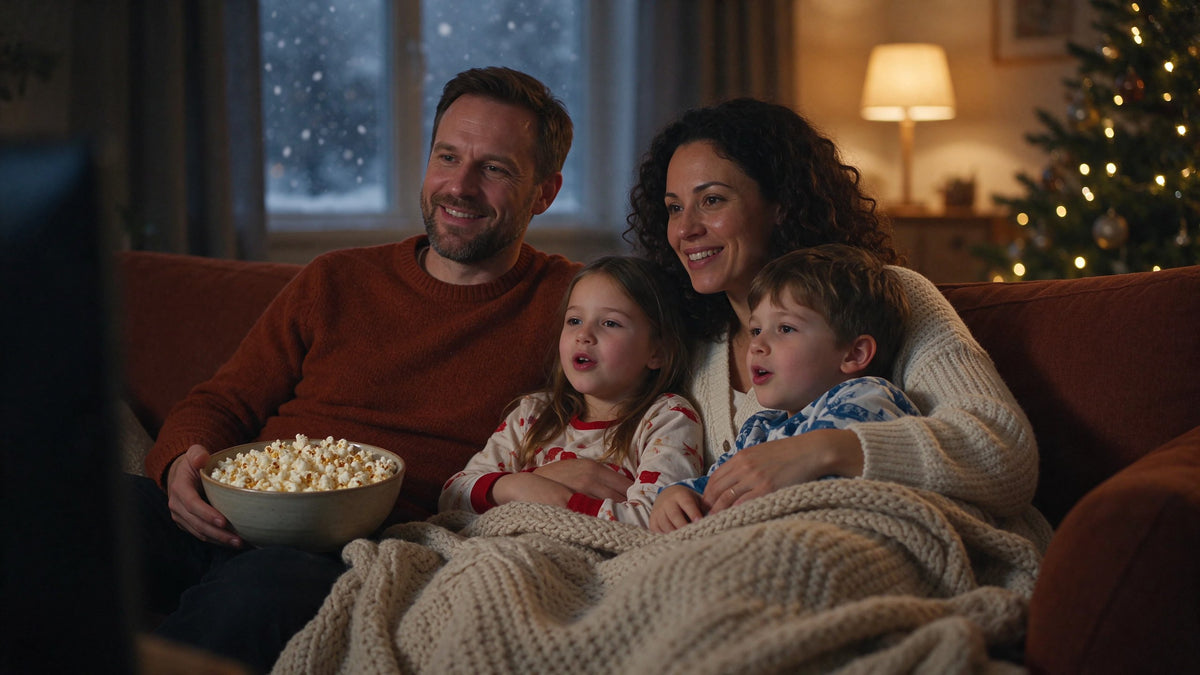
We rewatch movies because a repeat gives us more than we expect. Research suggests people enjoy a second viewing more than they predict, that knowing the ending need not spoil a story, and that familiar films and nostalgia may pull harder on cold nights.
It is the first cold weekend of the season. Someone reaches for the remote, and nobody needs to ask what is on. It is the same film as last year, and the year before that. You know every line before it is spoken. You know exactly when the music swells. And somehow that is the whole point.
Psychologists have studied that pull, and the answers are more interesting than "habit".
Why do we rewatch movies? Researchers have a name for it
Choosing to experience something again has a name in research: volitional reconsumption. In a 2012 study, Cristel Russell and Sidney Levy interviewed people about the books they reread, the movies they rewatch and the places they go back to (Russell and Levy, 2012).
They found that people did not simply repeat the experience. They steered it. Some went back for a feeling they knew they would get. Others found, on the return visit, richer and deeper insight into the film or book itself. They also saw how much they themselves had changed since the last time.
That second part fits holiday films well. The movie stays the same. You are the one who is a year older.
Is a movie less fun the second time?
Most of us assume a repeat will be a little dull. A 2019 paper by psychologist Ed O'Brien tested that assumption in seven studies with 3,356 participants in total (O'Brien, 2019).
In one study, people watched a movie in full. Then some of them predicted how much they would enjoy watching it again, while others actually watched it again. The predictors underestimated how much the rewatchers enjoyed it. In the first three studies, the gap held even when enjoyment did drop the second time.
The reason, O'Brien argues, is discovery. The first time through, we feel we have taken it all in. But a rich film holds far more than one viewing can absorb. The misprediction was larger for more complex material, and it tracked how much new detail people found on the repeat. A film you love is not one experience. It is many, layered on top of each other.
Do spoilers ruin a movie?
Every holiday classic ends the way you expect. That might sound like a problem. Research suggests it is not.
A 2011 paper by Jonathan Leavitt and Nicholas Christenfeld, published in Psychological Science, carried a title that sums up its finding: "Story spoilers don't spoil stories" (Leavitt and Christenfeld, 2011). The authors argue that suspense about the outcome may not be what makes a story enjoyable. It can even pull attention away from a story's details. The authors suggest that when you already know the ending, uncertainty may turn into warm anticipation of the moments you love.
You are not watching to find out what happens. You are watching for how it happens.

Why do familiar shows feel good after a long day?
There is another pull, and it is social. In 2012, psychologist Jaye Derrick asked what people choose to watch after a day that took a lot of effort and self-control (Derrick, 2012). Across an experiment and a daily diary study, people who had spent that effort tended to seek out familiar fictional worlds, such as a favorite TV program.
Immersion in those familiar worlds was linked to restored self-control afterward. Further analyses suggested the social side contributed to this: the familiar characters may work a little like company. Holiday films are full of exactly that kind of company, the same families, the same neighbors, the same jokes, year after year.
Why do holiday movies feel so nostalgic?
For many people, holiday films are also a trigger for nostalgia. Tim Wildschut and colleagues ran seven studies in 2006 on what nostalgia is and what it does (Wildschut and colleagues, 2006). People's nostalgic memories usually featured themselves with close others or at big life events, and they held more positive than negative feeling. In those studies, nostalgia strengthened feelings of social connection, raised positive self-regard and lifted mood.
Then there is the weather. Five studies led by Xinyue Zhou found that people reported stronger nostalgia on colder days, and in a cold room compared with a neutral or warm one (Zhou and colleagues, 2012). It went the other way too. Higher music-evoked nostalgia went with feeling physically warmer. And people who recalled a nostalgic event judged the room's temperature as higher than people who recalled an ordinary one.
So the season itself may nudge us toward the old favorites. A cold night, a familiar film and the people around you all point the same way.

What do you notice on the tenth watch? The sound
Once the plot is no longer news, you may find your attention drifting. For some people it goes to the sound: the score under a scene, the creak of a step, the swell before a reunion, the low rumble when the snowstorm hits.
For how a film's mix comes together, see our guide to why movie dialogue is so hard to hear. For the music that moves you in the big scenes, see why some songs give you chills.
What the research does not show
These studies measured how people felt and what they chose, mostly in lab tasks and diaries over short periods. O'Brien's movie study had people watch a movie once and then once more, not ten Decembers of the same classic. The spoiler paper tested short written stories, not films. The nostalgia studies captured feelings in the moment. None of them tested holiday movies as such, so the link to your December ritual is our own reading of the findings.
Where Woojer comes in
That low layer of a film's sound is what we build for at Woojer. Our OSCI technology reproduces 1 to 250 Hz, the band the body reads as pressure rather than pitch. A Vest 4 turns the low end of a film score into something your body feels, with no neighbors involved. A Strap 4 does the same in a smaller form, for a quieter film night at home. On the tenth watch, the storm and the swell reach you through contact as well as through your ears.
So press play again
The research on rewatching suggests repeats deserve more credit. A film you return to every year is a different film each time. You bring a different self to it. You notice more of what was always there. This December, press play on the old favorite without apology. You know every line. This time, listen for what sits underneath.
Frequently asked questions
Why do we rewatch movies? Research suggests a repeat holds more than we expect: in a 2019 set of studies, people who rewatched a movie enjoyed it more than others predicted.
Do spoilers ruin a movie? Not necessarily. A 2011 paper titled "Story spoilers don't spoil stories" tested short written stories, and its authors suggest knowing the ending can shift attention to the details.
Why do familiar shows feel good after a long day? In a 2012 experiment and diary study, people who had spent a lot of effort and self-control tended to seek out familiar fictional worlds, and immersion in them was linked to restored self-control.
No study cited here tested Woojer products, and Woojer is a wellness device, not a medical device. This article is for general information only and is not medical advice.
Sources
- Russell CA, Levy SJ. The temporal and focal dynamics of volitional reconsumption: a phenomenological investigation of repeated hedonic experiences. Journal of Consumer Research, 2012.
- O'Brien E. Enjoy it again: repeat experiences are less repetitive than people think. Journal of Personality and Social Psychology, 2019.
- Leavitt JD, Christenfeld N. Story spoilers don't spoil stories. Psychological Science, 2011.
- Derrick JL. Energized by television: familiar fictional worlds restore self-control. Social Psychological and Personality Science, 2012.
- Wildschut T, Sedikides C, Arndt J, Routledge C. Nostalgia: content, triggers, functions. Journal of Personality and Social Psychology, 2006.
- Zhou X, Wildschut T, Sedikides C, Chen X, Vingerhoets AJJM. Heartwarming memories: nostalgia maintains physiological comfort. Emotion, 2012.

